

Drainage and plumbing, Metrotown Burnaby
Drainage and Plumbing in Metrotown, Burnaby
Metrotown sits on top of the hill, not at the bottom of one. The City’s own plan calls it the Kingsway Ridge, and five watersheds start here before running off to the Brunette and the Fraser.
So when a Metrotown basement takes water, it is rarely a creek or a river. It is the water that landed on your lot and the private pipe that was meant to move it. We camera the line before anybody quotes a number.
Signs worth acting on in Metrotown
House north of Kingsway, unit in a Maywood low rise, tower off Central Boulevard. The symptoms read the same, and none of them get better on their own.
- Several drains through the building running slow at the same time
- A wet basement or crawl space every autumn, even in a building with no history of it
- Sewer smell in a unit, which is often a floor drain trap that has dried out and stopped sealing
- The toilet gurgles when the sink drains, which usually means the line is partly blocked further down
- The sump pump runs and runs and never shuts off
- Water staining a basement ceiling underneath a drain stack
- Standing water on a driveway or patio that used to drain away, which is normally a silted sand trap
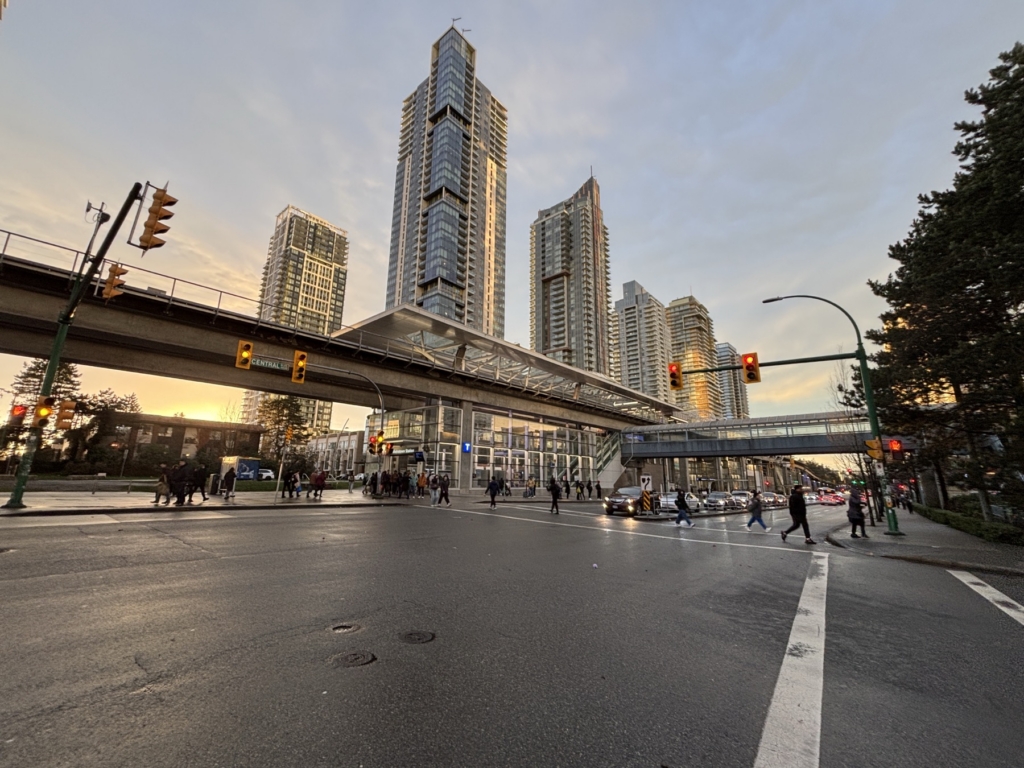
The pipe under your Metrotown street
Burnaby has all but finished separating its sewers. The City says only 7% of its sewers still need separation, and it names the two neighbourhoods: Burnaby Heights and Glenbrook. Metrotown is on neither list. Burnaby has spent nearly forty million dollars and separated close to half of its original 85 km of combined sewer, and it now runs 690 km of sanitary and combined mains, 23 pump stations and over 36,000 service connections. Two City combined outfalls are left, Gilmore and Westridge, and neither one is here.
That matters more than it sounds. On a Metrotown street the storm sewer is a storm sewer and the sanitary sewer is a sanitary sewer. Burnaby’s plumbing bylaw is blunt about mixing them: where both connections are available to a lot, no storm water goes into the sanitary sewer and no sewage goes into the storm sewer.
Your lot is meant to have its own storm connection too. The City’s engineering criteria say every legal lot gets a separate storm service connection, and shared services across a property line are prohibited unless the City Engineer has authorised one through a registered easement or covenant. Inspection chambers are required on all service connections. The connection is supposed to sit at the low point of the lot so the on site system drains by gravity.
If the street outside your place is separated but your own property still runs one combined pipe, Burnaby calls that partially upgraded, and there is a City grant to offset the cost of upgrading the connection. Worth asking about before you pay for the whole thing yourself.
The bylaw also sets the spec for what is meant to be around your foundation. Drain tile has to run the perimeter of any building with a floor below grade, with the top of the tile at its high point at least three inches below the lowest floor slab. It gets laid at a minimum 0.5% grade on undisturbed soil or gravel bedding, then covered top and sides with at least six inches of three quarter inch drain rock. Four inch tile serves a building up to 15,000 square feet and six inch above that. Dampproofing gets inspected and approved before anyone backfills, which is the one moment the whole assembly is visible.

Say the decade, camera the pipe, never guess the material
Metrotown is not one building type. The plan area covers 297 hectares between Boundary Road on the west, Royal Oak Avenue on the east and Imperial Street on the south, with a ragged northern edge that takes in Bond and Dover Streets. Inside it are over 12,000 homes and a census population of 34,087.
Maywood holds the biggest concentration of low rise apartments in the neighbourhood, and the City wrote in 2017 that many of those buildings were already over 50 years old and approaching the end of their lifespan. The mid rise buildings on Patterson Avenue, Nelson Avenue and Inman Avenue were developed in the early 1960s, 1970s and 1980s. The towers went up mostly through the 1970s, 1980s and 1990s, clustered west toward Kingsway, Grange Street, Patterson Avenue and Central Park. The single and two family houses that are left sit north of Kingsway, with the townhouses north of Kingsway and west of Halley Avenue.
That is the honest version. We can tell you what decade your building came out of, because the City dated the buildings. Nobody dated the pipe. So we put a camera in it and you watch the monitor with us, rather than us telling you what is probably down there.
What we do bring is the pattern. A tower built in 1978 and a low rise built in 1962 fail in different places, and the fix for one is the wrong fix for the other. Knowing the decade tells us where to put the camera first. It does not tell us what to quote.
24/7 emergency dispatch
Drainage problem in Metrotown?
Ryan picks up. Live dispatch, and you get a real arrival window on the call. We camera the line before anybody quotes a number, and no travel fee anywhere in Burnaby.
Metrotown drainage and plumbing FAQ
Not here. The City says only 7% of its sewers still need separation, and it names Burnaby Heights and Glenbrook as the two neighbourhoods. Metrotown is not one of them. Only two City combined outfalls are left, Gilmore and Westridge.
Burnaby calls that partially upgraded, a separated sewer in the street with an original combined sewer on the owner’s side. The City offers a grant to offset the cost of upgrading that connection. We can camera what you have so you know what you are applying for.
It depends what the sump discharges into. The bylaw requires a backwater valve in any storm sump whose outlet connects to a combined sewer. Where the system is separated, the Plumbing Inspector may allow a 90 degree bend in its place if storm sewer surcharge is unlikely.
Four inch drain tile for a building up to 15,000 square feet, six inch above that or to an engineered design. It has to be laid at a minimum 0.5% grade and covered top and sides with at least six inches of three quarter inch drain rock.
No. Burnaby wants driveway and patio runoff to pass through a sand trap interceptor first, with a trapping hood or a 90 degree bend on the outlet and a removable steel or concrete cover. Without it, grit goes straight down the line and settles.
You should not. The City’s engineering criteria say every legal lot gets its own storm service connection, and shared services across a property line are prohibited unless the City Engineer has authorised it through a registered easement, covenant or similar. A camera tells you which one you actually have.
Downhill, in every direction. Five watersheds start in Metrotown, Kaymar Creek, Gray Creek, Still Creek, Guichon Creek and Beaver Creek, and they all end up in the Brunette or the Fraser. Byrne Creek’s watershed runs from Kingsway south to the Fraser and spends a long stretch buried in storm pipe.
Most often a floor drain trap that has dried out and stopped sealing, or a defect in the drain stack. Both let sewer gas into the space. We find the source with a camera and a smoke or dye check rather than guessing at it.
Usually. Metrotown is dense and the yards are small, which is exactly where relining and pipe bursting earn their keep. We scope the line first and tell you which method the site actually allows before any digging is planned.
Yours. Burnaby’s flood prevention advice puts the foundation perimeter pipe on the property owner, asks you to keep the curb gutter and the catch basin next to your property clear, and to run your downpipes onto splash pads. The City clears street catch basins, inspects culverts and pulls debris out of the creeks.
24/7 EMERGENCY DISPATCH
Water where it should not be?
Ryan picks up. Live dispatch, and you get a real arrival window on the call.