

Drainage and plumbing, Renfrew Heights
Drainage and Plumbing in Renfrew Heights
Your street is called Dieppe or Normandy or Vimy because this hill went up in 1948 as federal housing for veterans coming home from the war. 157 houses on those 14 streets still carry a 1948 build year on the City tax roll.
That vintage is the whole drainage story here. We camera the line before anybody quotes a number, and the footage is yours.
The hill, the till and the pipe under your street
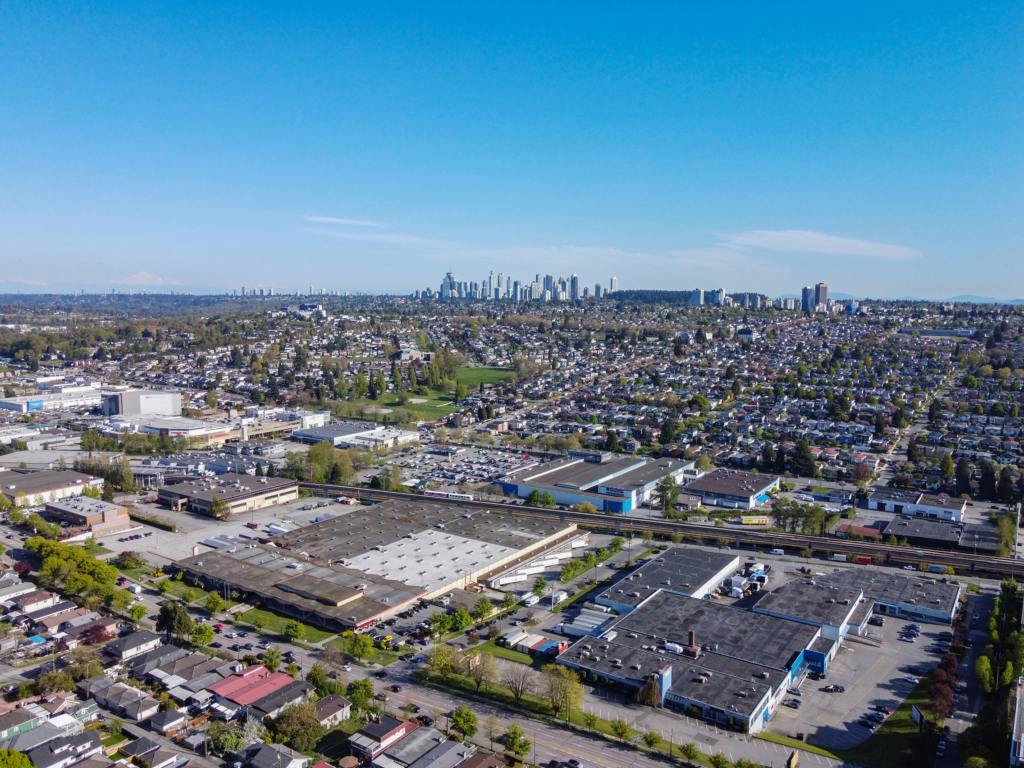
Renfrew Heights sits on the eastern edge of Vancouver against Boundary Road, between Rupert and Boundary, south of Grandview Highway. City contour data inside the neighbourhood runs from 24 metres at the Grandview Highway corner up to 88 metres at the south end. The high ground is the south. Everything drains downhill to the north and northwest.
Underneath that is glacial till. The Geological Survey of Canada maps till up to 25 metres thick as the dominant near surface material across the Vancouver upland, and its own words on the stuff are blunt: compact till is nearly impervious, and for good drainage the surface must slope. Soils on till are poorly drained compared with soils on sand and gravel. Rain does not soak away on this hill. It has to be carried.
Here is the part almost nobody tells you. The City’s sewer main dataset returns 476 main segments under Renfrew Heights and not one of them is combined. 209 sanitary, 267 storm, zero combined. Run the same query over a Kitsilano box and you get 284 combined segments. Over Grandview-Woodland, 103. This neighbourhood is already separated, so the 2050 sewer separation program that drives so much work on the west side is not your problem.
What is your problem is age and material. 356 of those 476 segments are vitrified clay, about three quarters. The City puts the life expectancy of an underground sewer main at roughly a century, and the mains here went in with the houses. 164 of the 250 water main segments under the subdivision carry a 1948 installation date, and 181 of them are cast iron. No dataset records what is under a private house, so we do not guess. The camera settles it.

A 1948 subdivision, rebuilt in patches
In 1948 the federal government cleared a forested hillside northeast of Collingwood and built hundreds of bungalows as low rental housing for Second World War veterans, on streets named after battles and the people who fought them. The names were originally going to come from wildlife. That got changed. Normandy Drive was named on 23 March 1948. Locals called the place Diaper Hill for the number of young families in it.
500 residential parcels sit on those 14 streets today and 497 carry a build year. 159 of them are from the 1940s. One is from the 1950s and three are from the 1970s, which is worth saying plainly because the old copy on this page claimed the neighbourhood was 1950s to 1970s stock and the tax roll says otherwise. The rebuild wave is much later: 57 parcels from the 1980s, 85 from the 1990s, 110 from the 2000s, 76 from the 2010s.
So roughly a third of the houses on Dieppe, Normandy, Vimy, Matapan, Worthington, Falaise, Malta, Haida, Mons and Seaforth are still the original 1948 build, and the rest is a patchwork of rebuilds sitting on lots that were graded in 1948. Two houses side by side can have completely different pipe under them. That is why we scope before we price, on every single call.
24/7 emergency dispatch
Water in a Renfrew Heights basement?
Ryan picks up. Live dispatch, and you get a real arrival window on the call. We camera the line before anybody quotes a number.
Renfrew Heights drainage and plumbing FAQ
No. The City’s sewer main dataset returns 476 segments under this neighbourhood, 209 sanitary and 267 storm, and zero combined. That is unusual for East Vancouver. The same query over a Kitsilano box returns 284 combined segments and over Grandview-Woodland 103. Nothing here is waiting on the 2050 separation program.
Because on this hill a wet basement is almost always the private side. You are responsible for the sewer lines on your property up to where they meet the City’s connection, so the lateral, the perimeter drain and the connection itself are yours. A camera tells you which of the three it is.
Glacial till. The Geological Survey of Canada maps till up to 25 metres thick as the dominant near surface material across the Vancouver upland and describes compact till as nearly impervious, needing slope to drain at all. Water that would soak into sand just sits and runs on till. That is why the perimeter system matters more here, not less.
The City ran a project it called the Renfrew Heights grouped replacement from 20 October 2023 to 1 October 2024, working block by block through Dieppe Drive, Malta Avenue, Malta Place, Haida Drive, Worthington Drive, Falaise Avenue, Falaise Place, Matapan Crescent, Vimy Crescent and Dieppe Place. Crews on that kind of work start at 7am. The City’s page notes that street, boulevard and sidewalk restoration can happen some time after the trench is filled.
Falaise Park is about 100 metres from the middle of Dieppe Drive and holds 16 black poplars, 3 black cottonwoods and 11 willows, with the largest poplar at 134.6 cm across and 32 metres tall. Poplars and willows are the species with the reputation for finding a clay joint. We will not tell you a specific tree caused a specific blockage. We will put a camera in and show you the root mass and where it comes through.
Depends what is overflowing. For a basement toilet, floor drain, tub or sink the City says call 3-1-1 and call a plumber. For an overflowing stormwater sump, for water seeping through basement walls and pooling, or for sewer odour inside the home, the City says call a plumber and does not ask you to call them.
It can. The City may charge for the service call if it determines the problem is not caused by the City water and sewer system, and someone who can authorise that charge has to be on site. Only the property owner can ask for a crew in the first place. A tenant cannot.
The mains went in with the houses. 164 of the 250 water main segments under the subdivision carry a 1948 installation date and 181 of them are cast iron. On the sewer side 356 of the 476 segments are vitrified clay. The City’s own figure for the life expectancy of an underground sewer main is about a century. What is under your particular house is not in any dataset, which is exactly why we scope it.
Yes, and your contractor handles it. The City requires permits before the work starts and an inspection after it is finished. It names three renewal methods: open trenching, pipe bursting and pipe relining. On a lot where the front garden and the walk are worth keeping, the two trenchless methods are usually the conversation.
All of Vancouver, plus Burnaby and New Westminster. Renfrew-Collingwood surrounds this neighbourhood, Hastings-Sunrise is north of it, and Boundary Road puts Burnaby on the other side of the street.
24/7 EMERGENCY DISPATCH
Water where it should not be?
Ryan picks up. Live dispatch, and you get a real arrival window on the call.