

Drainage and plumbing, Strathcona
Drainage and Plumbing in Strathcona Vancouver
Strathcona is Vancouver’s oldest neighbourhood. It runs east from Main Street to Clark Drive, between Hastings Street and Prior Street, and it has the strangest ground in the city.
The City graded these streets in the 1890s and left the lanes alone. So your front yard can sit below the road while your lane sits a storey higher. Getting a drainage plan wrong here is expensive, which is why we camera the line before anybody quotes a number.
Signs worth acting on in Strathcona
Two ages of house sit on the same block here, so the same symptom can mean two different things. These are the ones to call about.
- A wet basement every fall, or after any heavy rain
- Standing water in a yard that sits below the sidewalk
- Sewage coming up through a floor drain in a below grade room
- Slow drains on more than one floor at once
- A toilet that gurgles when the sink drains
- A sump pump that runs and does not shut off
- Water pooling at the back of the lot where the lane is higher than the yard
The City separated the street. It did not replace the pipe.
Count the sewer mains in the residential core, Prior to Hastings and Main to Clark, and you get 833 segments. 443 storm, 315 sanitary, 75 combined. Only 9.0% of them are combined, against 24.3% citywide. On that measure Strathcona is ahead of most of Vancouver, and the current story about the City not having got here yet is simply wrong.
Now look at what those pipes are made of. 402 of the 833 segments are a clay variant. That is 48.3% of everything and 62.0% of the segments where a material is actually recorded. Break it out by type and the sanitary main is the problem: 181 of the 315 sanitary segments are clay, 57.5%, and only 38 are PVC.
So the City put two pipes in the street and left the clay in the ground. Your house still has one old connection running out to meet them. Separated is not the same as new.
The rule the City applies to the private side is plain. It is working toward the Province’s goal of ending sewage overflows by 2050, and as it replaces combined systems with separated ones, properties will need separated systems too. Those private connections typically get separated as properties redevelop or take on major renovations. In a two pipe separated system rainwater is collected through catch basins, foundation drains and roof leaders and sent into the storm sewer, which means your foundation drain has a correct destination and a wrong one.
There are 1,170 catch basins in the Strathcona local area and 2,143 City street trees in the residential core. Maple, cherry and oak are the three commonest genera. Put those two numbers next to each other and October is the month that matters. The City’s own advice is to clear your catch basin of debris and litter before a rainfall.

Your yard may be below the street, and that is not settlement
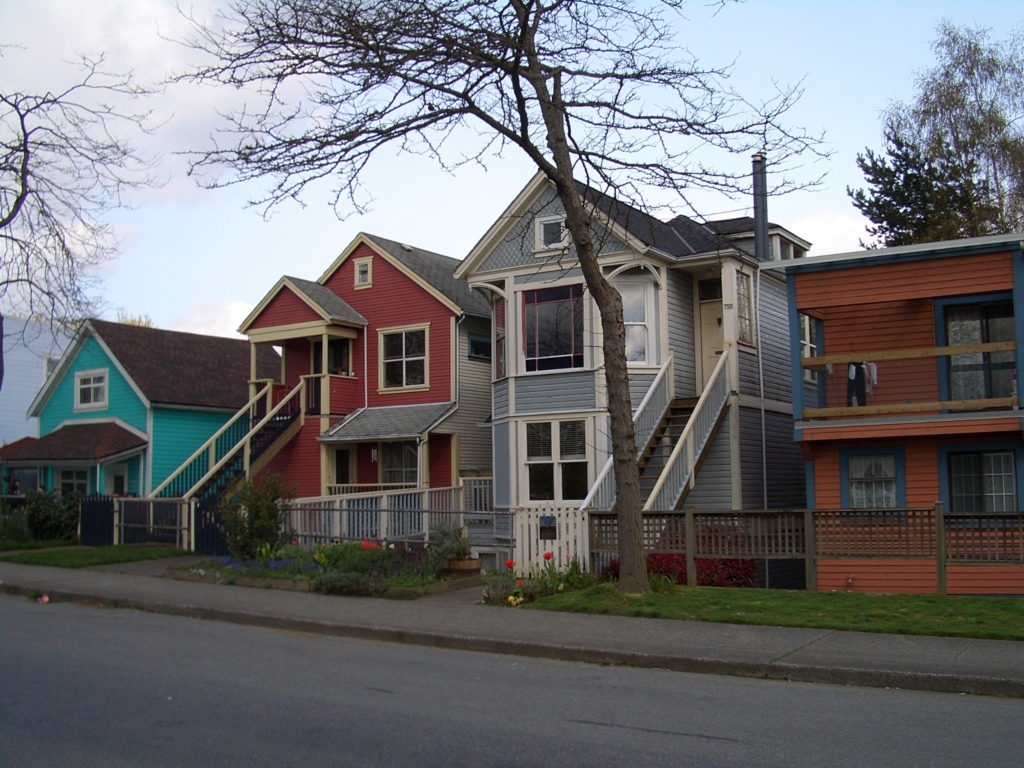
The City ran a street levelling program starting in the 1890s. Hills were cut down, depressions were filled, and the results here are more dramatic than in other neighbourhoods. The heritage record is specific about it. The streets were graded but the lanes were not, so the original geography is still sitting in your back lane. On Hawks Avenue the road was raised, so the row houses at that end have a full floor below grade. On the 600 and 700 blocks of Union the hill was cut down and the houses were left high above the street. On the 700 block of Pender the houses ended up below street level.
What that means for a drain is direct. A yard set below street grade cannot shed water to the street, so it needs a sump or a low connection. A house with a full floor below the level of the street main is exactly the situation a backwater valve exists for. And because the lane kept the original hill, the front and the back of one lot can be on completely different grades. A perimeter drain here has to be designed around that, not assumed.
The ground backs it up. Measured off the City’s one metre contours, Union Street runs across a ridge at Jackson and Princess around 19 m, falls hard through Hawks to a hollow at Campbell around 7 m, then climbs again at Raymur and Clark. North to south on Hawks it sits at 13 m at Hastings, 11 m at Keefer, 6 m at Prior and 4 m at Malkin. There is a reason for that hollow. Before European settlement False Creek reached as far east as what is now Clark Drive, and the heritage record describes filler pushed into the deep depression between Hawks and Heatley, which was a marshy tidal flat connected to the eastern basin. The Malkin Avenue edge was tidal basin and mudflat.
Two consequences. Malkin Avenue sits at 4 m and falls inside the City’s mapped Designated Floodplain, which models an extreme storm with a 1 in 500 annual probability plus a metre of sea level rise projected for 2100. Prior Street at 6 m is just outside it. And the south end cannot get its sewage out by gravity at all: the City runs the Raymur Pump Station at Raymur and Malkin, in the southeast corner of Strathcona Park, to move sewage from low points in the system uphill to gravity mains. It was built in 1962 and replaced in 2024 when it reached end of life.
24/7 emergency dispatch
Water where it should not be in Strathcona?
Ryan picks up. Live dispatch, and you get a real arrival window on the call. Camera first, then the number.
Strathcona drainage and plumbing FAQ
On a house of this age the perimeter drainage is the usual answer, but the grade is the thing to check first here. If your yard sits below the sidewalk it cannot shed water to the street at all, and no amount of new pipe fixes that on its own. We camera the perimeter and look at the levels, then quote.
Because the City raised the road. The street levelling program that started in the 1890s cut down hills and filled depressions, and Strathcona got it worse than anywhere. On Hawks Avenue the road was raised so the row houses at that end have a full floor below grade. On the 700 block of Pender the houses sit below street level. That is 1890s grading, not your foundation settling.
Probably not. In the residential core only 75 of 833 sewer main segments are combined, 9.0%, against 24.3% citywide. The City did the street separation here. What it did not do is renew the pipe, and 181 of the 315 sanitary segments are still vitrified clay.
Old clay, going out to more old clay. 57.5% of the sanitary main under these streets is a clay variant, and the connection from a house of that era was laid to the same standard. Clay is brittle, it cracks at the joint and roots find the crack. The camera tells you whether yours is blocked, bellied or broken, and those are three different jobs.
No, and anybody who tells you otherwise is guessing. Poly-B is a late 1970s to 1990s product, so a pre-war house did not get it when it was built. The houses to check are the infill built after the demolition plan was stopped: 134 of the 478 dated parcels on these streets are from the 1970s, 1980s or 1990s.
If you have living space below the level of the street main, it is worth pricing. On Hawks Avenue a whole row of houses has a full floor below grade because the road was raised over them. That is precisely the situation the valve exists for.
That is the Raymur Pump Station, in the southeast corner of Strathcona Park. The south end of Strathcona cannot get its sewage out by gravity, so the City lifts it from low points in the system up to the gravity mains. It was built in 1962 and replaced in 2024 when it reached end of life.
Often, yes. Relining and pipe bursting both avoid an open cut, and on a narrow lot with restored landscaping that is normally the first option we price. Site conditions decide it, and we tell you which one your property can actually take before any work starts.
No travel surcharge. Strathcona is central East Vancouver and we cover it on the same pricing as anywhere else in the city.
All of Vancouver, plus Burnaby, New Westminster and the North Shore. Strathcona’s actual neighbours are Downtown and Chinatown across Main to the west, the Downtown Eastside across Hastings to the north, Grandview-Woodland across Clark to the east, and Mount Pleasant to the south.
24/7 EMERGENCY DISPATCH
Water where it should not be?
Ryan picks up. Live dispatch, and you get a real arrival window on the call.