

Drainage and plumbing, Olympic Village
Drainage and Plumbing in Olympic Village Vancouver
Olympic Village is the one neighbourhood in Vancouver where the toilets flush with rainwater. The City required at least half of every roof to be vegetated and the rain off those roofs to be stored in basement cisterns, treated on site, and piped to toilets and irrigation through purple non-potable line.
That is live building plumbing, and it has its own failure list. We scope what is actually there before anybody puts a number on it.
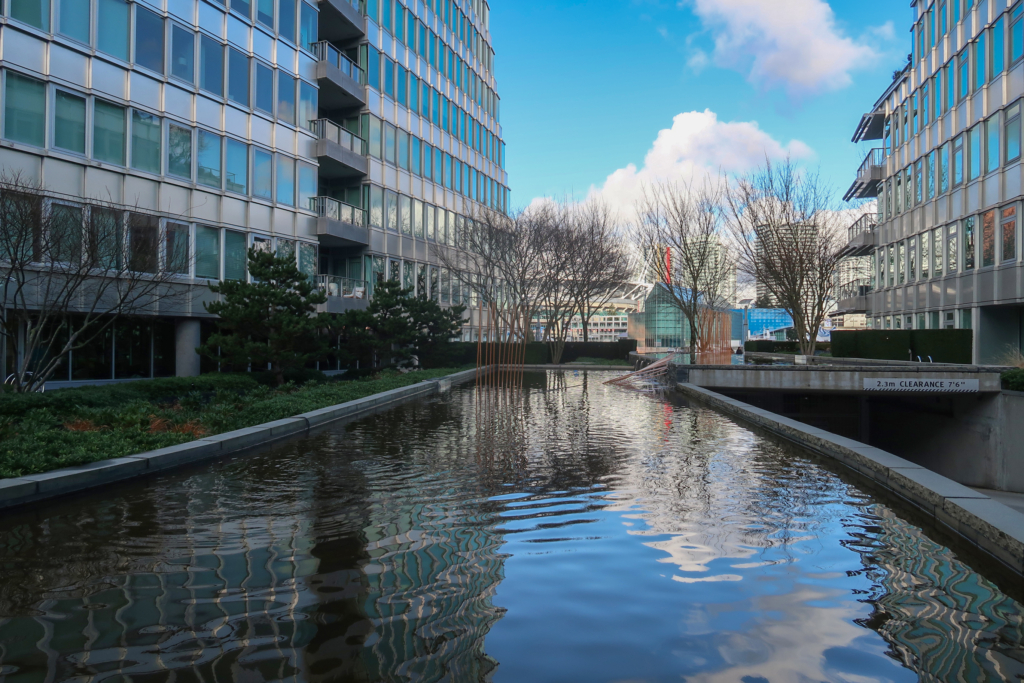
Nothing here soaks in, so everything is piped
The whole site is made ground over the old tidal flats. Before 1860 False Creek was five times its present size, reaching north to Pender Street and east to Clark Drive, and the eastern basin was infilled in 1917. The original shoreline ran through what is now the northwest corner of First Avenue and Manitoba Street, where the Salt Building stands. Sawmills, foundries, shipbuilders, railyards, metalworks and salt distributors were all here.
That industrial soil is capped. The cap is why the wetland in Hinge Park is lined, and it is why stormwater on this site does not infiltrate. It gets filtered and then sent to the storm sewer. Water in Olympic Village goes into a pipe, a swale or the wetland, or it sits.
The site is graded in two halves. The west two thirds, about 30,022 square metres, drains to Hinge Park. The east third, about 17,922 square metres, drains to the Ontario Street bioswale. The Plaza and the Salt Building were raised to be the high point, which is what makes the east side slope toward Ontario. The pond in Hinge Park is a daylighted storm sewer that overflows into False Creek, and it runs a circulation pump in dry spells when no stormwater is coming in.
Rain on the west side that does not reach Hinge Park ends up in infiltration galleries under First Avenue, where gravel and sand strip contaminants before the outfall. The SEEDS study flags a real weakness there. Those galleries were built with no access for inspection or clean out, so a failure inside them goes unseen. The Ontario Street bioswale inlets clog, photographed clogged on both a dry day and a wet one. Walter Hardwick Avenue was built with an inverted crown so water runs down the middle of the road on purpose, and the pavers have spread under the weight of cars.

Purple pipe, cisterns and brown toilet water
A UBC SEEDS field study of the Village, published in 2017, interviewed strata councils, City engineering staff and Parks staff about how the rainwater system was actually behaving. Four of the Village’s nine strata councils had already replaced or upgraded their rainwater treatment because of brown or yellow toilet water.
The original design used ozone treatment. Councils moved to UV, chlorine or other chemical treatment. Chlorine then attacked the rubber seals in the toilets, which meant replacing toilet parts. The costs the study lists for one building run from the filtration replacement itself through the consultant who recommended it, ongoing maintenance, parts and cistern cleaning.
The theme that came up over and over was that nobody on site knew how the system worked, so councils kept hiring outside consultants to tell them. That is the part we can help with. Purple pipe carries non-potable water, the cistern is in the basement, and the fixtures on the end of it are ordinary toilets that wear in ordinary ways. Knowing which of those three is failing is the job.
One thing the study is clear about, and it is worth saying out loud: the green roofs themselves did not leak. Leaking roofs were the original worry and they were not the problem.
24/7 emergency dispatch
Plumbing problem in Olympic Village?
Ryan picks up. Live dispatch, and you get a real arrival window on the call. In a strata building the first useful thing is knowing whose side of the line the fault is on, and that is what the camera settles.
Olympic Village drainage and plumbing FAQ
Because your building flushes with harvested rainwater. The City required at least half of every Village roof to be vegetated and the rain off it collected in basement cisterns, treated and piped to the toilets. A UBC SEEDS study found four of the nine Village strata councils had replaced or upgraded that treatment system over exactly this. If your tap water is clear and the bowl is not, the problem is on the non-potable side.
Non-potable water. That is the standard colour for it, and in the Village it is the harvested rainwater line running from the cistern to the toilets and the irrigation. Nothing on that line should ever be cross connected to a drinking water fixture.
It is a real recurring item here and it shows up in the SEEDS cost breakdown for a Village building alongside the treatment system, the consultant, regular maintenance and parts. The cistern is a storage tank in the basement collecting roof runoff, so it accumulates sediment. Cleaning it is maintenance, not a fault.
The SEEDS study records exactly that. Councils moved off the original ozone treatment to UV, chlorine or other chemical treatment, and chlorine treatment affected the rubber seals in the toilets, which meant replacing toilet parts. Worth knowing before you blame the fixtures.
Depends which side you are on. The west two thirds of the site drains to Hinge Park, the east third drains to the Ontario Street bioswale. The Plaza and the Salt Building are the high point, which is what tips the east side toward Ontario Street. Rain on the west that does not reach Hinge Park goes into infiltration galleries under First Avenue and then out to False Creek.
By design. That street was built with an inverted crown so stormwater flows down the centre rather than to the curbs. The pavers there are the standard non permeable kind and individual ones have dislodged under the weight of cars, so pooling on that street is usually the pavers rather than a blocked drain.
Less likely here than almost anywhere else in the city. The Village trees were planted in soil cells specifically to give roots room and protect the sewers from root damage. So on a slow line in Olympic Village we look at grease, scale, fixture connections and the shared stack first. We still camera it rather than assume.
Southeast False Creek buildings get space heating and hot water from the False Creek Neighbourhood Energy Utility, which generates most of its energy from sewage heat recovery and was expanded in 2024. So the answer is usually building side rather than a tank in your suite, and it is worth checking that before anybody starts opening walls.
False Creek is, and the Village sits on the south shore of it. The City’s sea level rise material counts more than 38,000 residents, a range of housing and emergency and medical facilities inside the False Creek floodplain. That is one more reason nothing on this site is designed to soak away.
All of Vancouver, plus Burnaby, New Westminster and the North Shore. The Village sits inside Cambie Street, Main Street, West 2nd Avenue and the water, so Mount Pleasant, Fairview, Strathcona and Downtown are all immediately next door.
24/7 EMERGENCY DISPATCH
Water where it should not be?
Ryan picks up. Live dispatch, and you get a real arrival window on the call.