

Drainage and plumbing, South Vancouver
Drainage and Plumbing in South Vancouver
South Vancouver was its own municipality from 1892 until it amalgamated with the City in 1929, and the southeast slope down to the Fraser still reads as one place. Victoria-Fraserview and Killarney, Knight Street across to Boundary Road, E 41st Avenue down to the river.
There is more clay sewer main under these streets than under any other neighbourhood in Vancouver. We camera the line before anybody quotes a number, and the footage is yours.
Elliott Street is the line, and it matters
The City publishes every sewer main it owns, and the two halves of this area could not be less alike. Under Victoria-Fraserview there are 1,714 street main segments and 47.3% of them are still combined, one pipe carrying sewage and rainwater together. Cross Elliott Street and Vivian Drive into Killarney and the figure is 0.0%. Killarney is the only local area in Vancouver with no combined main left at all. City wide the average is 24.3%.
Material is the other half of the picture, and here the two halves agree. 67.5% of the main under Victoria-Fraserview is vitrified clay, the highest proportion of any of the City’s 22 local areas. Killarney sits at 53.6%. The city as a whole is 44.8%. Clay cracks at the joint, and Metro Vancouver names holes and cracks caused by damage, age or tree roots as how groundwater and rain get into a sewer that was never meant to carry them.
What that means for you is simple enough. West of Elliott your street is probably still one pipe, so a heavy rain has to share a line with everything else on the block. East of Elliott the rain already has its own pipe. Either way the private lateral running from your house out to the City connection is yours, and on both sides of that line it is the same vintage of pipe.
The City is working toward the Province’s goal of ending sewage overflows by 2050. Private connections get separated as properties redevelop or take on a major renovation, and also where there is a documented history of blockages at the connection. Roof and foundation drains wrongly tied into the sanitary line are one of the things that has to come off.

One decade of houses, poured on a slope
Almost nothing here predates the war. Off the 2026 tax roll for the Fraserview and Killarney assessment neighbourhood, 2,631 parcels carry a build year and only 1.3% of them went up before 1940. 46.4% went up between 1950 and 1979, and the single biggest decade is the 1960s at 21.4%. That is a very unusual profile for Vancouver, and there is a reason for it.
The City tells the story itself. In the late 1940s there was a sudden shortage of housing for returning war veterans, and Victoria-Fraserview became home to 1,100 new houses. Canada Mortgage and Housing expropriated 182 hectares to do it. The build began in the 1940s and finished in the 1950s. Next door in Killarney, the bog south of what was then No. 1 Road, now E 45th Avenue, was drained and developed. Part of this neighbourhood is standing on ground that had to be dried out first.
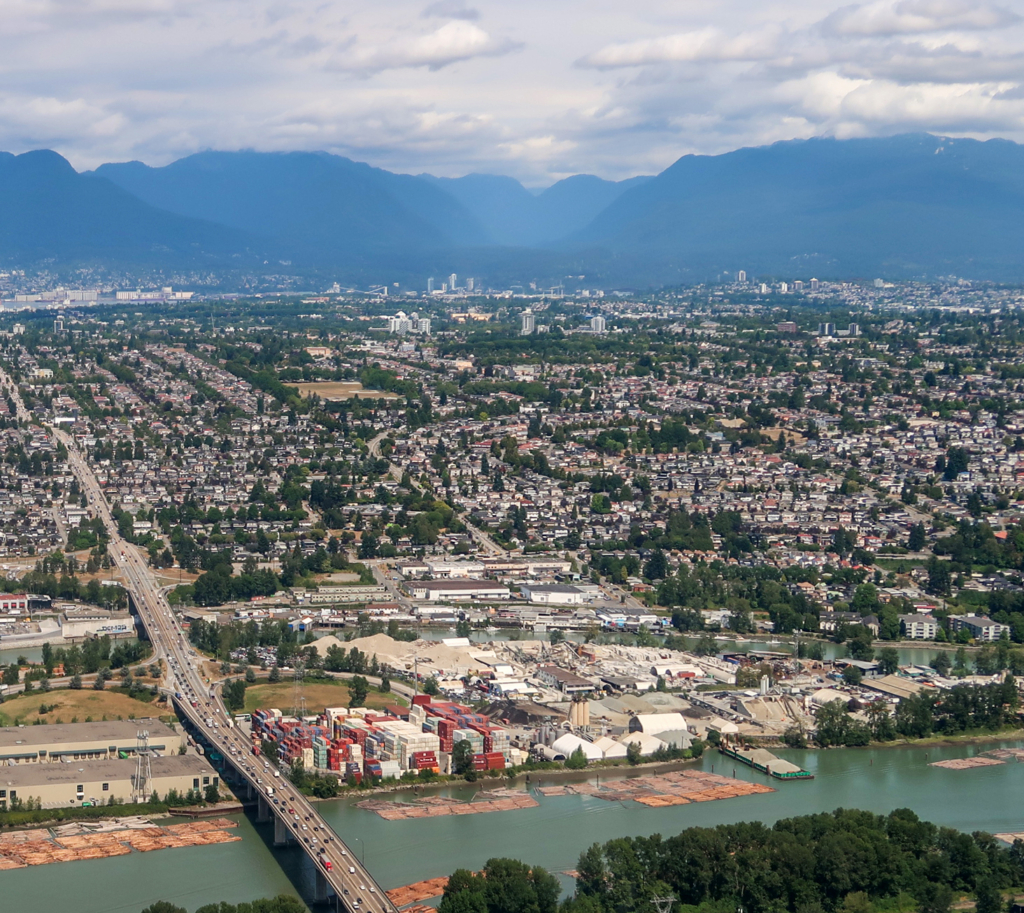
Then there is the fall. Two independent elevation models put the ground near 90 to 100 metres across the top of the area, holding roughly level down to about E 54th, then dropping hard below E 58th, with the last blocks before E Kent Avenue sitting within a few metres of Fraser River level. Water on your lot is not only your water. It is also whatever the blocks above you shed.
The Province has a standing advisory about exactly this ground. It says the area under artesian pressure is where the ground slopes south toward the Fraser in the southern part of Vancouver and Burnaby, and the City names Victoria-Fraserview and Killarney by name among its artesian areas. That is why deep digging on this slope gets handled carefully rather than casually.
One more thing that comes with the build years. 30.1% of the parcels here went up in the 1980s or 1990s, which overlaps the window when Poly-B was going into Canadian homes, roughly 1978 to 1998. It is usually grey and it is stamped PB2110. It is a supply pipe, not a drain, so it is a different conversation from your perimeter drains, but it is worth reading the pipe rather than guessing from the build year.
24/7 emergency dispatch
Drainage problem in South Vancouver?
Ryan picks up. Live dispatch, and you get a real arrival window on the call. We camera the line before anybody quotes a number, and you watch the monitor with us.
South Vancouver drainage and plumbing FAQ
Depends which side of Elliott Street you are on. Under Victoria-Fraserview, 47.3% of the street main segments are still combined. In Killarney it is 0.0%, the only local area in Vancouver with none left. The city average is 24.3%. We can tell you what is under your block before we come out.
Because there is more of it here than anywhere else in the city. 67.5% of the street main under Victoria-Fraserview is vitrified clay, the highest share of any of the City’s 22 local areas, and Killarney is at 53.6% against a city average of 44.8%. Clay cracks at the joint, and roots find the crack.
You are responsible for the lines on your property, up to where they meet the City’s connection. A licensed plumber can clean and inspect the whole connection from the house out to the main. Only the City or its agents work on the City’s portion inside the road right of way.
The City is working toward the Province’s goal of ending sewage overflows by 2050. Private connections are typically separated as properties redevelop or take on a major renovation, and also where there is a documented history of blockages at the connection. In practice it usually means getting roof and foundation drains off the sanitary line.
It does. The ground holds near 90 to 100 metres across the top of the area, drops hard below about E 58th Avenue, and the last blocks before E Kent Avenue sit within a few metres of river level. Water on a lower lot includes whatever the blocks above it shed, which changes the pump and the discharge point, not only the pipe.
It is, and it comes from the Province rather than from us. Its advisory says the area under artesian pressure is where the ground slopes south toward the Fraser in the southern part of Vancouver and Burnaby, and the City names Victoria-Fraserview and Killarney among its artesian areas. It is a reason to treat deep excavation on this slope carefully. It is not a reason to panic about a perimeter drain.
The 1960s is the single biggest decade here, 21.4% of the parcels, and 46.4% went up between 1950 and 1979. On stock that age the perimeter drainage and the sewer lateral are the two things worth scoping. We will not put an age on your particular line without looking at it, which is exactly what the camera is for.
Yes. Champlain Heights was planned in the early 1970s with curved roads and cul-de-sacs serving townhouse complexes and co-ops, so the drainage usually runs under common ground and the decision sits with a strata or a co-op council. We scope it, put the footage in front of the council, and quote from that.
No, and that distinction matters. Poly-B is a water supply pipe, not a drain pipe. It went into Canadian homes roughly between 1978 and 1998, it is usually grey, and it is stamped PB2110. 30.1% of the parcels here were built in the 1980s or 1990s, so it turns up. It is a separate job from anything to do with your drains.
All of Vancouver, plus Burnaby, New Westminster and the North Shore. Sunset, Victoria Drive, Kensington-Cedar Cottage, Renfrew-Collingwood, Oakridge and Marpole are the closest to this one and we are in them constantly.
24/7 EMERGENCY DISPATCH
Water where it should not be?
Ryan picks up. Live dispatch, and you get a real arrival window on the call.